There is a point on long show days when the room starts lying to you.
The crew is moving, the run of show is alive, lunch is sitting somewhere in your stomach, and your brain starts acting like someone dimmed the lights backstage. You reread the same Slack message twice. A tiny decision feels heavier than it should. You blame the carbs, the hotel coffee, the client, the air conditioning, or the fact that you were answering emails at 11:47 p.m. again.
Some of that may be true. But the bigger issue is simpler: your body has a schedule, and event work loves to ignore it.
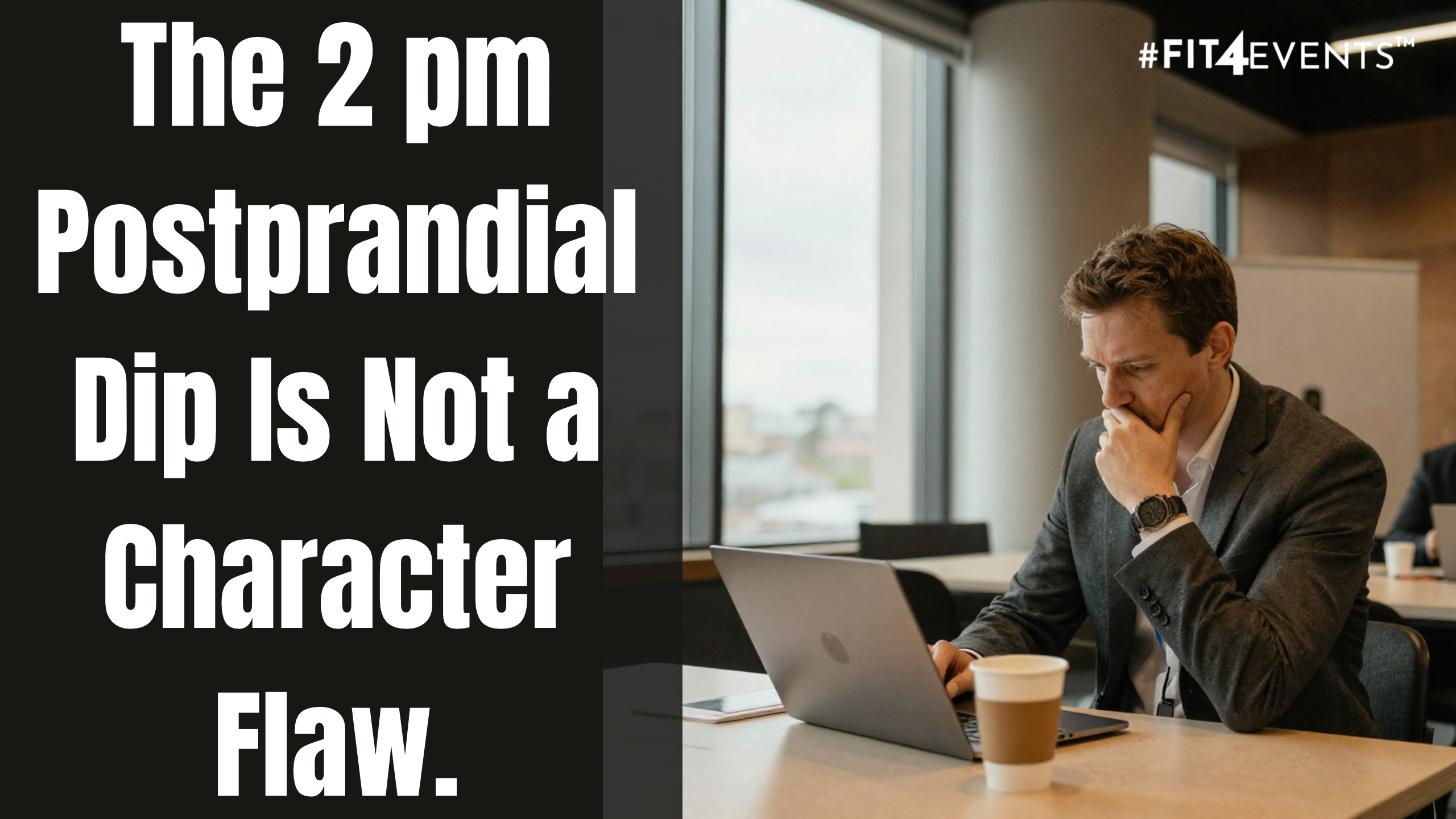
The 2 p.m. dip is not a weak-attendee problem.
It is not a lazy-crew problem. It is a human-design problem.
Most events still stack some of the most fragile attention work into the exact window when biology is already pulling focus down. Lunch ends, the lights drop, people sit again, the keynote starts, the slides get dense, the ballroom gets quiet, and then we act surprised when attention starts leaking out of the room.
That is not a character flaw. That is a planning flaw.
The afternoon dip is real. It is predictable. It is also manageable if you stop treating energy like a lucky accident and start designing the day like humans are involved.
Your energy has a low tide
Most people hit a natural alertness dip somewhere between 1 and 4 p.m. Lunch often gets blamed because the timing is convenient, but research suggests the body clock is already pulling attention down during that window.
One study replaced lunch with small hourly sips of a liquid supplement and the afternoon dip still appeared. Other circadian research points in the same direction: the slump can show up even without a normal meal.
That should change how we think about event agendas.
For event professionals, the dip rarely arrives during a quiet moment. It shows up during breakouts, load-in decisions, speaker handoffs, client check-ins, budget calls, or the glamorous moment when someone asks why the confidence monitor is not showing notes.
For attendees, it usually shows up right when the program expects them to absorb, remember, participate, network, and look alive under ballroom lighting after sitting through lunch.
Then we call it disengagement.
Sometimes it is not disengagement. Sometimes it is poor energy design.
If your agenda only works when people override biology, the agenda is the problem.
The 2 p.m. slot tells on your event design
The post-lunch block is one of the most revealing parts of an event.
- If the schedule has no breathing room, the 2 p.m. dip exposes it.
- If the meal was heavy and unbalanced, the 2 p.m. dip exposes it.
- If the room is dark, cold, and passive, the 2 p.m. dip exposes it.
- If the program has been all intake with no movement, no reset, and no change in energy, the 2 p.m. dip exposes it.
This is why the post-lunch window should not automatically become the dumping ground for dense content, sponsor panels, compliance sessions, or anything that requires deep attention and zero friction. That slot needs more care, not less.
Put your highest-retention content before lunch or after a real reset.
Use the early afternoon for formats that help the body come back online: movement, facilitated peer exchange, smaller discussions, hands-on labs, outdoor moments, walking meetings, sponsor activations with actual usefulness, or calm reset lounges where people can recover before the next push.
This is not about making events softer. It is about making events work.
A tired audience does not retain your content. A depleted crew makes more mistakes. A planner running on caffeine and cortisol is not doing their best strategic thinking. Everyone pays for bad energy design.
David T. Stevens®, PMED, WITT-AP has been teaching this in a very practical way through his Meals and Movement segments, and he deserves a shoutout here. His work keeps bringing planners back to a simple truth: the agenda lives inside a human body. If you feed people a heavy lunch, sit them back down, dim the lights, and ask them to absorb dense content, you are making attention harder than it needs to be. Meals and movement have to be designed together. The plate, the pacing, the walk, the stretch, the hydration break, the reset before the next content block, all of it shapes whether people come back alert or drift into the 2 p.m. fog. David has been doing important work in this lane, and the event industry needs more of it.
Lunch can make the dip better or worse
The body clock may start the slump, but lunch can pour fuel on it.
A huge, low-fiber, mostly refined-carb lunch can make the crash hit harder, especially after short sleep. That does not mean carbs are the villain. It means the plate needs a little adult supervision.
For a production day lunch, aim for boring competence:
- Protein you can actually digest before you have to move again.
- Fiber from vegetables, beans, lentils, oats, berries, or whole grains.
- A portion that feeds you without putting you into hibernation.
- Water before the third coffee becomes your personality.
Fiber deserves more respect here. It is one of the cheapest performance tools on the table, and most adults do not get enough of it. Higher fiber intake is linked with lower risk of early death, heart disease, stroke, and type 2 diabetes. In the short term, it also helps make meals steadier instead of turning lunch into a blood sugar carnival ride.
Start slowly if your current fiber intake is low. Add one real source at a time. Your gut will have opinions if you go from zero to lentil evangelist overnight.
For event planners, this means lunch is not just hospitality. It is programming support.
A menu can help the next session succeed or quietly sabotage it. Heavy pasta, dessert, dim ballroom, and a 90-minute slide deck after lunch is basically a crime scene with lanyards.
The ten-minute walk is not a wellness fantasy
A ten-minute walk after lunch sounds almost too simple, which is why busy people dismiss it.
Do it anyway.
Post-meal movement helps your body handle the meal, gives your attention a reset, and gets you out of the chair before the slump hardens. If you can get daylight while you walk, even better. Bright light helps nudge alertness back up.
On event days, this does not need to look precious. Walk the back hallway. Take the long route to check signage. Step outside during the one call that does not require a laptop. Eat lunch on a bench if the venue has one and the weather is not actively insulting you.
For attendees, build movement into the program before they have to sit again. Do not make people choose between recovering and missing the next session. That choice is lazy design.
A post-lunch walk-and-talk, sponsor-hosted hydration station, guided stretch, outdoor networking loop, or five-minute room reset can do more for attention than another “please take your seats” announcement shouted into a room full of half-conscious adults.
Related research found that people who spent at least two hours per week in nature were more likely to report good health and high well-being. That works out to about 17 minutes a day. You do not need a mountain. A patch of sky counts.
Caffeine is a tool, not a rescue mission
Coffee can help in the early afternoon if your bedtime allows it. A cup around 12 or 1 p.m. may be useful before a demanding block of work. A late-day refill is different. That one often steals from tonight and bills you tomorrow.
Tea is worth considering when you need focus without the edgy feeling. Tea pairs caffeine with L-theanine, an amino acid that may soften the jittery side of caffeine and support steadier attention. Reviews of randomized trials suggest the combination can help attention within an hour or two, though many studies use more L-theanine than one cup of tea provides.
Practical version: use caffeine on purpose. Do not sip it all day because you are tired and hoping the next cup fixes a schedule that is breaking you.
For crews, planners, speakers, and attendees, caffeine should support the day. It should not be the emergency patch for a program that ignores sleep, food, movement, and recovery.
Close the open loops before they tax you all day
The afternoon crash is not only food and sleep. It is also the weight of too many unfinished things.
A meta-analysis on worry and rumination found that repeated mental replay can slow cardiovascular recovery after stress. The stressful moment ends, but the mind keeps reopening the file.
Event work is full of open files: unanswered approvals, unclear ownership, travel friction, a client concern nobody wants to name, a budget question hiding in plain sight. None of them may feel dramatic. Together, they quietly drain the body that has to carry the day.
Before the afternoon block, try a two-minute closeout:
- Write down the loose ends you keep mentally touching.
- Give each one a next step, an owner, or a time to revisit it.
- If it is not yours to solve today, say that clearly and stop feeding it attention.
The goal is not a perfect mind.
The goal is fewer invisible tabs open while you are trying to lead.
This also applies to event agendas. If attendees leave every session with ten new ideas and no processing time, they carry cognitive clutter into the next room. By 2 p.m., they are not just tired. They are overloaded.
Build in reflection. Build in transition. Build in white space that has a job.
A break is not automatically recovery. A hallway packed with noise, sponsor scans, coffee lines, and Slack catch-up may be a pause on paper, but it is not always a reset.
Practical takeaways
- Expect a 1 to 4 p.m. energy dip and plan important work with that in mind.
- Do not place your densest, highest-retention content in the post-lunch trough without a reset first.
- Build lunch around protein, fiber, and a portion that will not flatten you.
- Take a ten-minute walk after lunch, preferably with daylight.
- Use caffeine strategically in the early afternoon, not as an all-day drip.
- Add fiber slowly and consistently. Beans, lentils, oats, berries, avocado, chia, barley, vegetables, and even plain popcorn can help.
- Before the afternoon push, write down open loops and give each one a next action or owner.
- Give attendees a real recovery path after lunch: movement, daylight, peer exchange, quiet reset, or a format change.
- If you crash hard every day, especially with unusual thirst, shakiness, or heavy fatigue, talk with a qualified medical professional.
Before your next heavy afternoon block, pick one move: protein and fiber at lunch, a ten-minute walk, or a two-minute open-loop list. Do it today, not when the calendar gets polite.
And if you are designing an event, stop asking the 2 p.m. session to fight biology alone. Give people a meal, a reset, a reason to move, and a room that helps them come back online.
That is not extra wellness programming. That is better event design.
Research and resource notes
- Afternoon dip can appear even without a traditional lunch: https://pubmed.ncbi.nlm.nih.gov/8877121/
- Circadian timing and daytime sleepiness research: https://pubmed.ncbi.nlm.nih.gov/15892914/
- Meal composition and post-lunch sleepiness: https://www.sciencedirect.com/science/article/abs/pii/S0031938411005555
- Bright light and alertness: https://www.frontiersin.org/journals/public-health/articles/10.3389/fpubh.2021.652849/full
- Two hours per week in nature and well-being: https://www.nature.com/articles/s41598-019-44097-3
- Email checking limits and stress: https://www.sciencedirect.com/science/article/abs/pii/S0747563214005810
- Worry, rumination, and cardiovascular recovery: https://pubmed.ncbi.nlm.nih.gov/26689087/
- Caffeine plus L-theanine review: https://academic.oup.com/nutritionreviews/article/83/10/1873/8123998
- Creatine and hair loss review: https://doi.org/10.1186/s12970-021-00412-w
- 12-week creatine and hair follicle randomized trial: https://www.ncbi.nlm.nih.gov/pmc/articles/PMC12020143/
About the Author
Anca Platon Trifan, CMP, WMEP (Wellness Meeting Event Professional) helps high-performing event professionals build the energy, cognitive capacity, and mental discipline required to lead and perform under constant pressure. Her work blends elite performance principles with real-world event work, focused on sustainable leadership in high-stakes environments. A competitive bodybuilder and triathlete with over 20 years of experience in event production and event technology, Anca brings a rare perspective to the stage. As CEO of Tree-Fan Events Production LLC, she works with teams to strengthen how they manage stress, make decisions, and sustain peak performance across demanding event cycles. She is the host of Events: demystified Podcast and founder of the #fit4events™ Fit Mindful Mavens, a high-performance framework designed to help event leaders train their energy, attention, and resilience with the same rigor they bring to their work.
About #Fit4Events™
#Fit4Events™ Fit Mindful Mavens was founded by Anca Platon Trifan, CMP, WMEP, a cognitive and physical resilience strategist for leaders and event professionals. The work focuses on expanding mental, emotional, and physical capacity so leaders and event professionals can sustain energy, strengthen resilience, and perform at a high level in demanding environments. The framework links human performance to production excellence by strengthening the human capacity behind strategy, execution, and leadership. Learn more: https://treefanevents.com/fit4events/
Interested in bringing Anca to your event, leadership team, or organization? Schedule a conversation here, to explore keynote speaking, workshops, leadership training, and #fit4events™ programs.