
The Numbers Behind the Hype
The conversation about AI for event planners has been running for years. In 2026, we finally have enough data to separate signal from noise — and the picture is more nuanced than either the skeptics or the boosters predicted.
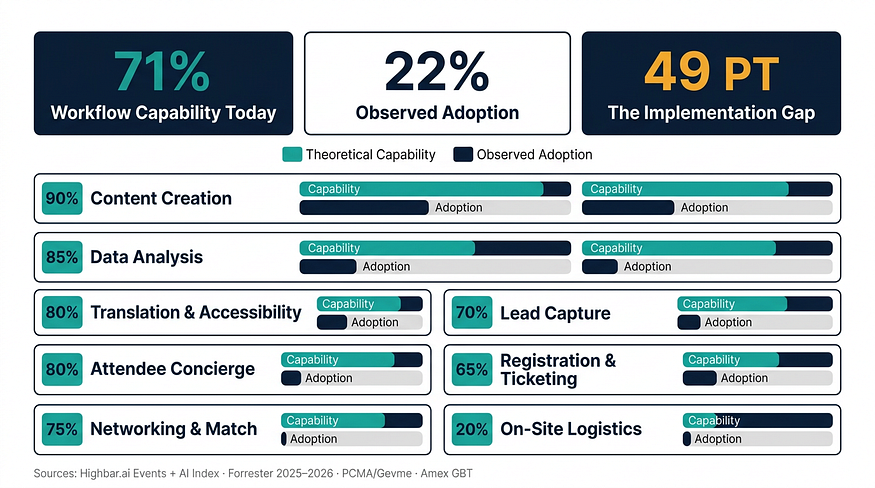
71% of event workflows can be augmented or handled by AI today (Highbar.ai / Forrester 2026)
22% observed real-world adoption across the industry (Highbar.ai Index, March 2026)
49pt implementation gap between what’s possible and what’s deployed (Highbar.ai Index)
That gap, 49 points between capability and deployment, is the story. According to the Highbar.ai Events + AI Index (drawing on Forrester 2025–2026 B2B Events research, PCMA/Gevme AI Pulse Check, Northstar/Cvent PULSE, and Amex GBT/YouGov data across 1,800+ respondents), 91% of event professionals are using AI in some capacity. But only 15% qualify as strategic leaders. The rest are experimenting in isolation, without the system architecture to make their experiments compound.
The Cvent/Northstar PULSE Survey (1,000+ planners across corporate, association, and agency) tells a similar story: 65% report using generative AI, yet only 16% say it has significantly improved their planning and execution. The tools are there. The workflows are not. The question for 2026 is not whether to adopt AI. It’s how to build the systems that make individual AI uses compound into operational advantage.
1. Content Creation: The Safest Starting Point , and the Most Underused
Content creation remains the most adopted AI use case in events — and still has enormous room to grow. Forrester’s 2025–2026 B2B events research shows 39% creating content with AI in 2025, climbing to 43% for repurposing content in 2026. The PCMA/Gevme AI Pulse Check (92 respondents) puts content adoption at 46%. The Amex GBT/YouGov 2026 Global Meetings & Events Forecast (601 respondents across 8 countries) shows 31% actively planning AI deployment for content creation.
The reason content wins is structural: it is asynchronous, low-stakes, and human-reviewed before anything reaches an attendee. That makes it the ideal entry point. But planners who stop at content generation are leaving the bigger value on the table.
What a Mature Content Workflow Actually Looks Like
The governance infrastructure matters: review workflows, brand voice guardrails, and role-based permissions are what separate one-off experiments from reliable systems. Full architecture breakdown: Generative AI for Event Planners in 2026 (Event Technology).
2. Where AI Adoption Lags — and Why the Gap Matters
Not all AI applications are equally adopted. The Highbar.ai Index scores 8 event management functions on both theoretical capability and observed adoption. Three areas stand out for their low adoption despite high capability:
Attendee Concierge (68-point gap): AI is capable of answering attendee questions, providing wayfinding, and handling routine requests with high accuracy. Only 7% of planners are using AI chatbots at events (Forrester 2025), and 11% report AI use for customer service (PCMA/Gevme). The barrier is not technology — it is trust. A wrong answer at a live event is immediate and visible. Adoption is accelerating as platforms add source-grounding and fallback-to-human functionality.
Networking and Matchmaking (60-point gap): Intent to adopt is high — 35% plan AI-powered matchmaking (Amex GBT). Execution lags because most legacy platforms lack the data architecture to deliver meaningful recommendations. The platforms that perform well explain why two people should meet based on attendee goals and behavior, not just that they share a category tag.
Lead Capture and Attribution (57-point gap): AI could connect event engagement signals to pipeline outcomes and automate lead scoring. In practice, most teams still rely on badge scans and manual CSV exports with no closed-loop attribution. The gap here is not technical capability — it is that event data and CRM data rarely live in the same system.
The implementation gap is not an AI readiness problem. It is a systems design problem. The technology exists. The data architecture and workflow design to use it effectively often does not.
See the full breakdown of capability vs. adoption across all 8 event functions: Highbar.ai Events + AI Index. For how planners are actually using gen AI, the PCMA AI Pulse Check is essential reading.
3. Predictive Analytics: Moving from Reporting to Foresight
Descriptive analytics tells you what happened. Predictive analytics tells you what is about to happen. For event planners, that distinction changes everything — from staffing decisions to session scheduling to revenue optimization.
The Amex GBT 2026 Forecast shows 36% of planners intend to use AI-powered ROI measurement tools in 2026, and 28% plan AI for post-event evaluation. The industry is also shifting from ROI to ROE (Return on Experience) — a qualitative measure that AI is well-positioned to quantify at scale through survey synthesis, sentiment tracking, and behavioral analytics.
Where Prediction Delivers the Biggest Operational Lift
The infrastructure requirement is a centralized data lake — not five separate platform dashboards. Without unified identity resolution and normalized data streams, predictive outputs are noise. Full architecture detail: Predictive Analytics in Event Management (Event Technology).
4. The 2026 Event Tech Stack: Integration Is the Product
The biggest mistake event teams make with technology is buying platforms. The winning move is building an ecosystem. Every tool added to your stack should be evaluated on one question first: does it talk to everything else?
The data infrastructure gap shows up clearly in the numbers. The Skift Meetings 2025 roundup identified data fragmentation as the defining barrier to AI adoption across event platforms. Amex GBT confirms it: 63% of planners cite data quality as a barrier to AI effectiveness. You cannot run a predictive analytics engine on siloed spreadsheets.
In 2026, seamless integration is no longer aspirational. It is the operational baseline for competitive event execution. — Event Technology
The Layers That Must Communicate
- Registration and identity management — the central data gateway that syncs automatically to every downstream system
- Access control and credentialing — RFID, NFC, and facial recognition feeding bi-directionally into registration
- Engagement and audience intelligence — polling, sentiment analysis, gamification, and sponsor activation tracking
- Marketing automation and CRM — behavioral triggers initiating automated workflows in real time rather than on static schedules
- Analytics and business intelligence — a unified data lake ingesting all platform outputs into a single source of truth
- AI and automation layer — the orchestration intelligence sitting across the entire stack
- Post-event intelligence — content distribution, sponsor ROI reporting, and CRM lifecycle triggers extending beyond the event date
Vendor selection should prioritize integration compatibility over isolated feature depth. See the full stack architecture: The Ultimate 2026 Event Tech Stack (Event Technology). Also useful: 10 Essential AI Tools for Event Planning (Cvent).
5. Digital Twins and AI Assistants: On-Site Service at a New Level
The chatbot era is effectively over. What has replaced it in high-performing event environments is a category of AI assistant that is context-aware, behaviorally adaptive, multimodal, and wired directly into venue operations through a digital twin.
A digital twin is a real-time virtual model of your venue — floor plans, booth configurations, HVAC systems, entry points, crowd density — continuously updated by IoT sensors, access control logs, Wi-Fi triangulation, and computer vision. AI assistants read from this model to answer questions, trigger workflows, reroute attendees, and alert operations teams before problems escalate.
Planners remain cautious here — and understandably so. The PCMA AI Pulse Check found that 59% cite data privacy as their top AI concern, and attendee-facing AI deployments carry the highest visibility risk. The platforms gaining traction are those that add source-grounding (AI only answers from your event content) and explicit fallback-to-human handoffs.
What Changes on the Ground When This Works
Full operational and compliance framework: Beyond Chatbots: Digital Twins and AI Assistants in 2026 (Event Technology).
6. AR Wayfinding: Solving Navigation at Scale
At mega-conferences, navigation is not a minor inconvenience. It is a friction point that directly causes missed sessions, congested hallways, frustrated attendees, and inflated staff workload. Augmented Reality wayfinding has become one of the most practical immersive technology deployments in events because it solves a real problem with measurable outcomes.
AR navigation overlays directional arrows, room markers, estimated travel times, and accessibility routes directly onto a device camera view — powered by indoor positioning infrastructure (Bluetooth beacons, Wi-Fi triangulation, ultra-wideband sensors) and cloud-based routing engines that update dynamically as conditions change.
The Amex GBT 2026 Forecast reports that 40% of planners expect AI-powered event apps to be standard by 2026 — a category that increasingly includes AR navigation embedded within official event apps, automatically guiding attendees to their next scheduled session without requiring manual map interpretation.
Full deployment guide: Augmented Reality Wayfinding: Eliminating Attendee Friction at Mega-Conferences (Event Technology).
7. Virtual Reality: The ROI Case Has Arrived
VR has been on the events industry radar for over a decade. For most of that time, the business case was weak. Standalone headsets, inside-out tracking, integrated spatial audio, and wireless operation have removed the technical barriers that made VR impractical for exhibitions and corporate events.
The strongest ROI argument is asset reuse. VR content built for an event can extend into sales presentations, training programs, and digital marketing campaigns across multiple channels. For industries where physical product transport is logistically impractical — aerospace, automotive, healthcare equipment, industrial engineering — VR demonstrations replace shipping and logistics costs while providing richer engagement data than any physical display.
Behavioral analytics inside VR environments — session duration, interaction frequency, content completion rates, navigation paths — generate higher-quality lead qualification data than traditional booth conversations. This is increasingly recognized in the planning community: the Event Industry News / EventMobi AI Report 2025 identified immersive technology ROI measurement as one of the fastest-evolving capabilities among advanced event organizations.
Full ROI analysis and deployment requirements: The True ROI of Virtual Reality in 2026 (Event Technology).
8. Designing Intentionally for Two Audiences
Hybrid is not streaming a live event. That distinction matters operationally. Streaming is a broadcast. Hybrid is a design problem that requires equal intentionality for two separate audience experiences running simultaneously on shared infrastructure.
The Amex GBT 2026 Forecast shows that 50% of planners are integrating AI into their planning workflows, with AI-powered engagement tracking (31%) and AI for post-event evaluation (28%) among the most planned deployments. For hybrid events, these capabilities become essential — the alternative is managing two separate data streams manually and hoping they tell a coherent story.
Core Infrastructure That Cannot Be Skipped
Redundancy planning is non-negotiable. Convene’s guide to AI in event planning notes that hybrid event failures are disproportionately caused by single points of failure in streaming infrastructure, backup cameras, secondary streaming endpoints, and alternative speaker communication channels are operational requirements, not contingency luxuries. Full infrastructure framework: Hybrid Event Technology: Infrastructure, Integration, and Operational Strategy (Event Technology).
9. Connected AI Workflows: Where the Real Advantage Is Built
Here is the thread that runs through all of the above. The Highbar.ai Index identified that the implementation gap is not primarily a technology problem, it is a workflow architecture problem. The professionals building a real advantage in 2026 are not using more AI tools. They are designing connected workflows where each step feeds the next without manual re-entry.
PCMA research confirms this: the 15% of event professionals operating as AI “strategic leaders” share one defining characteristic, they have moved from using AI for individual outputs to using AI to redesign how work flows across the entire event lifecycle. The PCMA AI study is direct: the gap between leaders and the majority is systems design, not tool access.
Workflow Patterns That Already Exist in the Field
- Expense and receipt management — receipts from email, photos, and uploads flow into categorization, validation, and reconciliation-ready structured reports automatically
- Speaker content management — decks, bios, and session descriptions processed through version control, alignment checks, and formatting standardization without manual back-and-forth
- Run of show generation — agenda and technical riders converted into detailed, dependency-structured production documents that bridge planning and execution teams
- Lead scoring and CRM sync — event engagement signals (session attendance, booth interactions, content downloads) scored and pushed to CRM within 24 hours instead of raw badge scan exports
The shift is not from slow outputs to fast outputs. It is from isolated tasks to connected execution across the full event lifecycle.
What This Means for You
The aggregate picture here is a role evolution, not a role replacement. AI does not eliminate the need for creative direction, stakeholder judgment, or operational leadership. It eliminates the volume of repetitive cognitive labor that used to consume those leaders.
What the data tells us, across Forrester, PCMA, Amex GBT, Cvent, and the Highbar.ai Index — is that most of the industry is at the same place: using AI, not benefiting from it at scale. The planners who close that gap in 2026 will not be the ones who try more tools. They will be the ones who design better systems.
The skills that differentiate high-performing event professionals in 2026:
- AI workflow design and prompt engineering
- Data architecture literacy — understanding where systems connect and where they break
- Governance fluency — knowing when to automate and when to require human review
- Cross-functional collaboration with data engineers, AV technologists, and platform vendors
- Ethical judgment on tracking, consent, and personalization limits
For a grounded, data-driven view of where the industry actually stands right now, the Highbar.ai Events + AI Index is the most useful single resource available in 2026.
For practical how-to guidance, How Event Planners Can Use AI in 2025 from Convene remains current and actionable.

👋 Hi, I’m Anca. I help teams harness AI for smarter workflows, stronger content, and better decisions, without the overwhelm or cognitive overload, via one-on-one consultations, bespoke AI workshops, both virtual and in-person, as well as global keynotes + workshops.
I offer tiered consultation packages so your team stays ahead. I show up weekly and break down the latest AI news, tools and systems released that month so you don’t have to chase trends. tailor AI system recommendations based on your actual workflow, so everything I show you is relevant, not random. I train you on the tools, agents and systems you actually want to use, saving you dozens of hours you’d lose watching high-level webinars with no tactical substance. 📩 Let's connect to see which tier is the right one for you.