
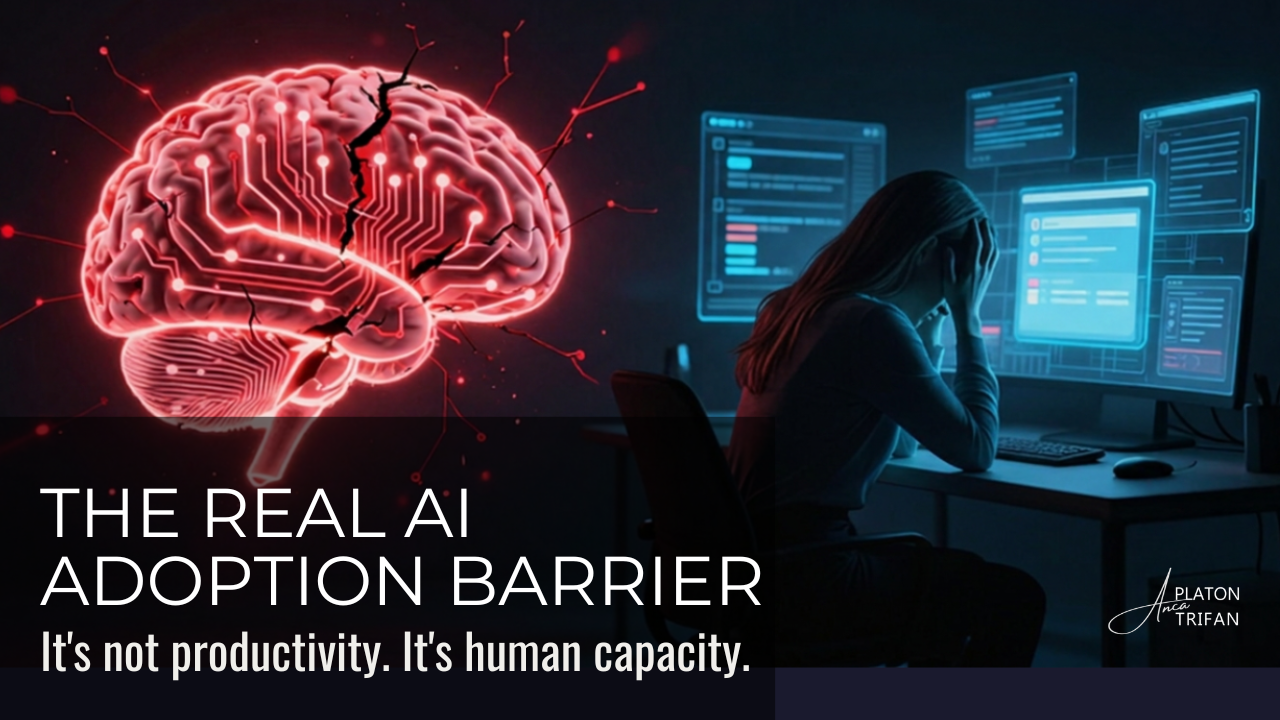
AI adoption is not simply a technology shift, and it is definitely not just a productivity conversation, it's a human capacity conversation, a pressure conversation, a leadership conversation, a systems conversation, and if organizations keep treating AI like another tool rollout instead of a redesign of how people think, decide, collaborate, and carry work, they are going to keep wondering why the promised efficiency gains do not translate into meaningful adoption.
The other day, a good friend - thank you Victoria Matey, MSc - sent me an HBR article titled “The Psychological Costs of Adopting AI,”and I read it with that familiar mix of professional validation and quiet frustration because, in many ways, it put research language around something I have been saying from stages, in keynotes, and inside AI workshops for a while now, and it clearly makes the case that companies are overwhelmingly framing AI adoption around productivity and efficiency, while ignoring the psychological cost employees absorb when AI changes how they work.
The author calls this hidden burden psychological debt, and breaks it into six forms:
- cognitive debt,
- autonomy debt,
- competency debt,
- relatedness debt,
- credibility debt, and
- identity debt.
In plain terms, AI can make people feel like they are thinking less, controlling less, knowing less, connecting less, being trusted less, and becoming less of the professional they worked hard to become. That should stop every leader in their tracks, because these are not soft side effects, these are adoption barriers, the reasons people quietly avoid AI, hide how they use it, misuse it, overuse it, or comply just enough to say they are “using AI” while still doing the real work the old way.
This is exactly why I keep saying that AI does not fix chaos. It reveals it.
It reveals the quality of your workflows, the clarity of your decision-making, the trust inside your culture, the strength of your documentation, the maturity of your leadership, and the amount of invisible load your people were already carrying before anyone handed them another login. AI walks into the organization like a mirror with a motor attached.
It reflects what is already there, then speeds it up.
If your systems are connected, your context is clean, your roles are clear, and your people understand where their judgment still matters, AI can expand capacity in a meaningful way. If your systems are fragmented, your data is messy, your expectations are vague, and your teams are already burned out, AI does not become relief. It becomes compression.
So much of the AI conversation is still being sold as speed, faster drafts, faster summaries, faster emails, faster research, faster meeting notes, faster workflows, faster everything.
And yes, speed matters.
I have spent more than two decades in AV production and live events, so I do not need anyone to explain the value of speed to me, in live production, nano-seconds matter, response time matters. A slow decision at the wrong moment can turn a small issue into a show-critical problem. But speed without context is not operational excellence, it's just acceleration, and acceleration inside a weak system does not create confidence.
It creates stress.
That is where the psychological debt conversation becomes so important.
When an employee feels cognitive debt, they are not simply “bad at AI,” they may be sensing that they are outsourcing the thinking before they have clarified the problem.
When an employee feels autonomy debt, they may not be resisting innovation, they may be responding to the feeling that AI is being done to them instead of designed with them.
When an employee feels competency debt,they may not be insecure, they may be watching a tool produce polished outputs in seconds and wondering whether their years of experience still matter to the organization.
When an employee feels relatedness debt, they may not be antisocial, they may be slowly replacing peer discussion, debate, and shared sense-making with a private conversation inside a chatbot.
When an employee feels credibility debt, they may not be hiding something unethical, they may be working inside a culture that has not yet decided whether AI use is smart, lazy, strategic, risky, expected, or embarrassing.
And when an employee feels identity debt, they may not be dramatic, they may be reacting to the very real experience of seeing the craft they built their professional identity around reduced to a feature in a software demo.
That is information, not resistance, and leaders need to pay attention to it.
Because the real question is not, “How do we get people to use AI?”
That question is too shallow.
The better question is, “What conditions need to exist for people to use AI responsibly without losing agency, judgment, confidence, credibility, connection, or trust?”
That is the strategy conversation. Not the license count. Not the tool stack. Not the leaderboard of who prompted the most this month.
Actual adoption is not proven by access. A login is not an adoption strategy. A training session is not a culture shift. A policy document is not psychological safety. And a shiny demo is not proof that the system can hold under real pressure.
I see this constantly in my AI keynotes and workshops, especially with event professionals, business leaders, and teams being asked to do more with less while also learning tools that seem to change every week. People are not just asking, “What tool should I use?”They are asking deeper questions, even when they do not phrase them that way.
They are asking,
- “Where do I start without feeling behind?”
- “How do I know if the output is right?”
- “What can I safely put into this tool?”
- “What happens to my expertise if AI can draft the thing I used to be praised for creating?”
- “Am I supposed to become faster, or am I supposed to become better?”
And underneath all of that, they are asking, “Do I still matter in this new version of work?”
That question is the one too many organizations are avoiding.
And here is where I think the HBR article is right, but where I would push the argument further: psychological debt is not only a human reaction to AI, it's more often than not the emotional expression of operational debt.
If people feel overwhelmed by AI, it may be because the workflow was already unclear. If they feel anxious about using it, it may be because expectations were never defined. If they hide their AI use, it may be because the culture has not created responsible norms. If they do not trust the outputs, it may be because the data going in was messy, incomplete, or disconnected. If they feel less competent, it may be because leadership has talked so much about automation that people no longer hear where human expertise remains essential.
This is why tool-first AI adoption is such a weak strategy. Tools are not irrelevant, but tools are not the foundation.
- The work is the foundation.
- The workflow is the foundation.
- The decision structure is the foundation.
- The trust layer is the foundation.
- The human review process is the foundation.
- The context is the foundation.
And when those pieces are missing,
AI becomes one more thing employees have to manage, explain, validate, defend, and emotionally negotiate on top of the work they already had.
I often describe AI as a junior teammate, and I mean that very intentionally. A junior teammate can be incredibly useful, they can draft, organize, summarize, compare, analyze, research, and help move work forward. But you would never hand a junior teammate a vague mess, give them no context, refuse to define success, and then blame them when the output misses the mark. You would onboard them. You would explain the goal. You would give examples. You would clarify the boundaries. You would tell them what decisions they are allowed to make and what needs to come back to a human. You would review their work. You would build trust over time. AI needs the same level of operational clarity, except most organizations are skipping that step and calling it innovation.
In live event production, this would be absurd. No serious production team would walk into show day with unclear tech roles, disconnected AV production flows and systems, missing cue sheets, missing gear, and then assume that this new piece of technology never tested on a show before will magically hold the show together. The show does not care about your intentions, it will reveal the truth, and whether the plan was clear, whether the team had shared context, whether the tools were configured correctly, whether the client approvals were locked, whether backup plans existed, and whether the humans in the room knew how to respond when something changed. AI adoption works the same way. Under calm conditions, almost any AI tool can look impressive. Under pressure, the truth comes out.
That is why I keep coming back to my Event Endurance Equation:Event Endurance = (System Connectivity × Context Integrity × Automation Rate) ÷ Manual Intervention Load

The same logic applies to AI adoption.
If your systems are not connected, AI creates more chasing.
If your context integrity is poor, AI produces confident nonsense.
If your automation rate increases faster than your team’s ability to understand and trust the workflow, people resist or disengage.
If manual intervention stays high, AI does not reduce the load. It becomes another layer of work. The point is not to add AI into chaos and hope it saves everyone. The point is to redesign the work so the system carries more of the load and the humans can bring more judgment, creativity, leadership, and presence to the moments that actually require them.
This is the heart of my “AI as a human capacity expander”message.
I am not interested in AI as a way to squeeze more output out of already exhausted people. That is lazy strategy wearing a futuristic outfit. I am interested in AI as a way to help people think better, decide with more context, reduce repetitive drag, surface risks earlier, communicate more clearly, and protect the human energy needed for work that actually matters. Human capacity is not just about how much more people can produce. It is about how much complexity they can absorb without breaking. It is about whether they can make better decisions under pressure. It is about whether they can stay connected to the purpose, the craft, and the people around them while the pace of work keeps accelerating.
That is where leaders need to get much more precise.
AI strategy cannot only answer, “What tool are we using?”
It has to answer,
- “What work are we redesigning?”
- “Where does human judgment remain non-negotiable?”
- “What do we want AI to draft, suggest, organize, compare, or automate, and what must still be reviewed, challenged, approved, or owned by a person?”
- “How will people know when the AI is wrong?”
- “What does responsible use look like here, in this role, with this data, under these conditions?”
And maybe most importantly, it has to answer,
- “How do we make sure people do not feel erased by the very tools we are asking them to adopt?”
Because people do not adopt tools in a vacuum, they adopt tools inside cultures, inside power structures, inside teams with histories, politics, trust issues, status concerns, and unspoken fears, while trying to protect their credibility, while wondering if efficiency will become the excuse to reduce headcount, while trying to understand whether leadership actually wants better work or just more work faster.
Ignoring that reality is not strategic. It is convenient.
This is why the next phase of AI adoption has to be much more human-centered, but not in the vague, decorative way that phrase is often used.
Human-centered AI adoption means starting with the actual work people do, not the tool someone wants to sell them.
It means:
- mapping where the friction lives,
- identifying the repetitive decisions, handoffs, bottlenecks, approval loops, context gaps, and manual interventions that drain capacity,
- designing workflows where AI supports the thinking instead of replacing the thinker,
- creating shared norms so people can openly say, “I used AI for this part, and here is how I reviewed it,”
- training people by role and context, not throwing generic prompt tips at everyone and pretending that is enablement,
- measuring more than usage, also measuring confidence, quality, rework, decision speed, trust, and whether the work actually feels more manageable.
And it means leaders have to stop confusing compliance with adoption.
If people use AI because they were told to, that is not adoption. If people use AI secretly because the culture has not caught up, that is not maturity. If people use AI to generate more output while their judgment, energy, and confidence erode, that is not progress. If people are moving faster but collaborating less, that is not a win. If people are producing more polished work but understanding less about the problem, that is not intelligence. That is debt. And eventually, debt comes due.
The organizations that will do AI well are not necessarily the ones with the biggest budgets or the longest tool lists. They will be the ones mature enough to understand that AI adoption is a redesign of the relationship between people, work, technology, and trust. The ones that protect thinking while improving speed, that make expertise more visible, not less. They will be the ones that normalize responsible AI use without shaming people into silence, the ones that understand where automation helps and where it creates risk. They will be the ones that build systems strong enough to expand human capacity without turning every employee into a permanent quality-control department for machine output.
So yes, the HBR article is right: AI adoption has psychological costs.
But I would take it one step further. Those costs are not side notes, they show us where the organization is unclear, where the culture is fragile, where the workflow is weak, and where people are carrying more pressure than leaders may want to admit.
AI is not just changing work.
It is revealing the condition of the work.
And the leaders who understand that will have a much better chance of building AI strategies that people can actually trust, use, and sustain.
🔄 Share this if you learned something new from this article.

👋 Hi, I’m Anca. I help teams harness AI for smarter workflows, stronger content, and better decisions, without the overwhelm or cognitive overload, via one-on-one consultations, bespoke AI workshops, both virtual and in-person, as well as global keynotes + workshops.
I offer tiered consultation packages so your team stays ahead. I show up weekly and break down the latest AI news, tools and systems released that month so you don’t have to chase trends. tailor AI system recommendations based on your actual workflow, so everything I show you is relevant, not random. I train you on the tools, agents and systems you actually want to use, saving you dozens of hours you’d lose watching high-level webinars with no tactical substance. 📩 Let's connect to see which tier is the right one for you.